
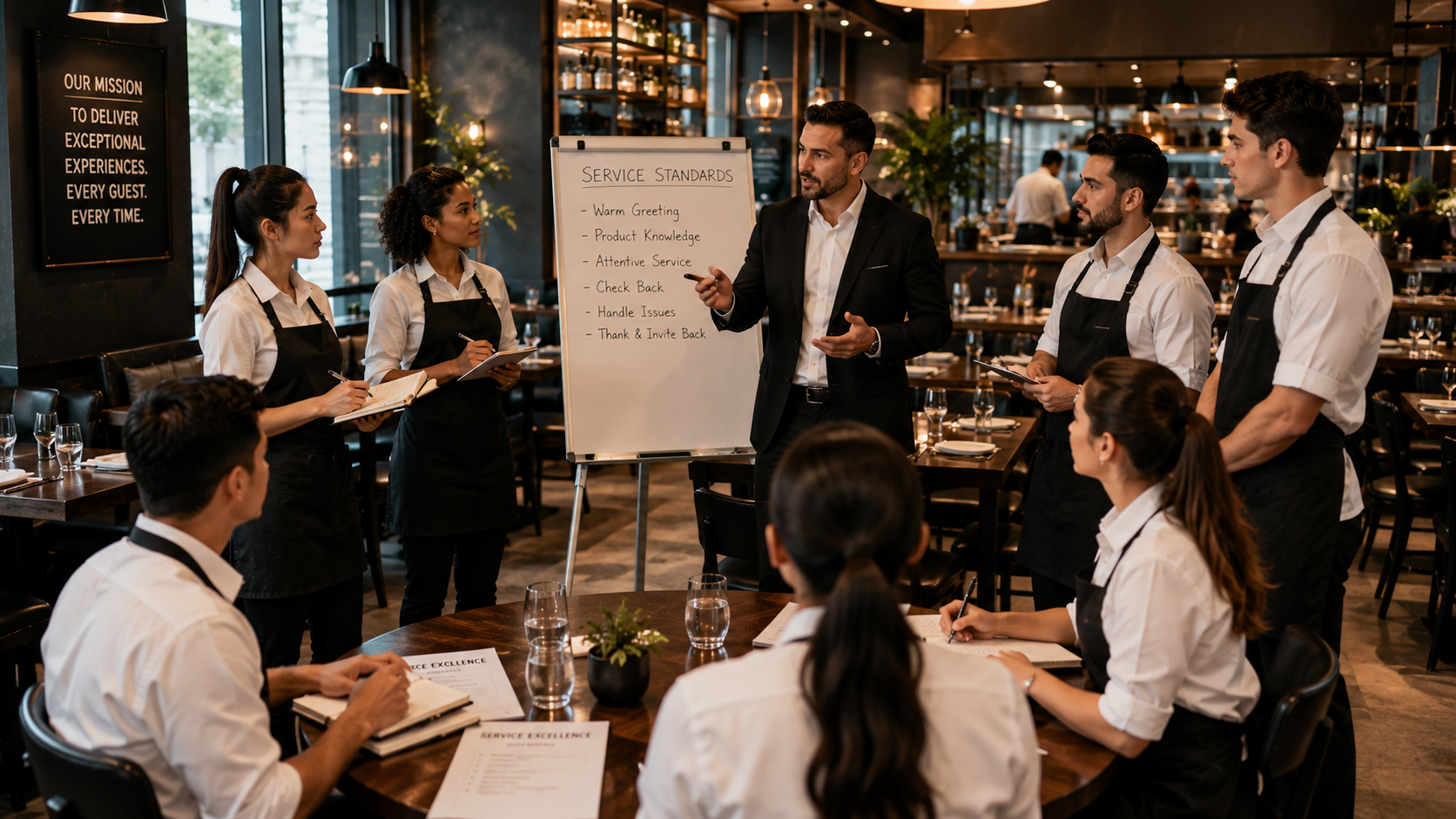
Restaurant employees directly influence the customer experience.
They prepare food, interact with guests, manage orders, solve problems, maintain cleanliness, and represent the brand throughout every shift.
Yet employee training is sometimes treated as a one-time onboarding activity.
That approach can create serious operational challenges.
Effective training should be considered a long-term business strategy because employee performance directly influences service quality, customer satisfaction, operational efficiency, and profitability.
First Impressions Start With Employees
Customers often judge a restaurant within the first few minutes of entering.
How employees greet guests, communicate, respond to questions, and manage the initial interaction can influence the entire experience.
Training gives employees clear expectations.
Instead of assuming employees will naturally understand the desired service style, restaurant leaders can teach specific behaviors and standards.
Consistency Is Critical
Restaurant customers expect consistency.
They want the same quality whether they visit on a Monday afternoon or Saturday evening.
They also expect employees to understand menu items, service procedures, payment processes, and customer recovery standards.
Consistent training creates consistent performance.
This becomes increasingly important as restaurants grow.
Training Reduces Operational Mistakes
Errors cost money.
Incorrect orders, poor food handling, inventory mistakes, payment errors, and communication problems can all affect profitability.
Training reduces these risks by giving employees clear procedures.
Employees should understand not only what to do, but why the process matters.
When employees understand the impact of their actions, they are more likely to follow standards.
Create Role-Specific Training
A strong training program should be customized to each position.
A server does not need the same training as a line cook.
A manager does not need the same training as a host.
Role-specific training may include:
Front of House
- Guest service
- Menu knowledge
- Order accuracy
- Upselling
- Complaint resolution
- POS procedures
Back of House
- Food preparation
- Portion control
- Food safety
- Cleaning
- Inventory handling
- Kitchen workflow
Management
- Scheduling
- Labor management
- Financial reporting
- Team leadership
- Performance management
- Customer recovery
This approach makes training more practical and relevant.
Teach Employees the Brand
Employees are part of the brand experience.
If a restaurant positions itself as premium, employees should understand what premium service means.
If the brand focuses on speed and convenience, employees need systems that support efficiency.
Brand values should not remain inside a marketing document.
They should become visible through employee behavior.
Invest in Leadership Development
Restaurant growth requires leaders.
Instead of constantly hiring managers from outside the organization, businesses can develop leadership talent internally.
High-performing employees can be given additional responsibilities, coaching, and management training.
This creates a stronger internal talent pipeline.
It also gives employees a reason to see long-term career opportunities within the organization.
Training Should Continue
One of the biggest mistakes restaurants make is treating training as something that happens only during onboarding.
Skills can decline.
Processes can change.
New products can be introduced.
Technology can be updated.
Customer expectations can evolve.
Ongoing training keeps teams aligned.
Short weekly coaching sessions, monthly refreshers, manager meetings, and performance reviews can make continuous development part of the restaurant culture.
Measure Training Results
Training should produce measurable improvements.
Restaurant leaders can track:
- Customer complaints
- Order accuracy
- Employee turnover
- Service times
- Waste
- Sales performance
- Customer reviews
- Manager performance
If training is successful, operational metrics should gradually improve.
Training Can Improve Retention
Employees are more likely to stay when they understand their responsibilities and see opportunities for development.
Poorly trained employees can feel overwhelmed.
Employees who receive structured support are more likely to develop confidence and competence.
A strong training culture can therefore contribute to both performance and employee retention.
Build Systems That Scale
Training becomes even more important during expansion.
When a restaurant opens additional locations, new employees need to learn the same standards quickly.
Documented training materials, checklists, videos, manuals, role-specific guides, and management development programs can make this process easier.
A scalable training system allows the business to grow without reinventing the onboarding process every time a new employee joins.
The Bigger Picture
Operations management is not simply about processes and numbers.
It is about people.
Black Apron’s hospitality management approach emphasizes operational systems, team training, staffing, inventory control, and performance optimization as interconnected parts of building stronger hospitality businesses.
Final Thoughts
Employee training should never be viewed as an expense that simply gets new employees ready for their first shift.
It is an investment in the entire restaurant.
Well-trained employees create better experiences, make fewer mistakes, operate more efficiently, and provide stronger support for business growth.
When people understand the standards, systems, and purpose behind their work, the entire restaurant becomes stronger.
